20260827_
Once again, I am writing a new blog post, and once again, I am posting about a new game I made: WITH TEETH, my entry for Pervert Jam 2026. It’s been a really productive year for me on the gamedev front, eh? The idea for WITH TEETH has been bouncing around in my head for a while, and the one-week-long Pervert Jam was the perfect chance to just sit down and get it out there– plus, after the week-long game scripting sprint to get WHAT HATH GOD WROUGHT done on time, it was nice to sit down and work on something where my focus was primarily writing.1
Truth be told, as a bit of a jack-of-all-trades when it comes to making VNs, writing is the sub-craft that I feel least confident in. (While I have talked about this here before, when I skeeted about this on bluesky it was a surprise to my followers, evidently.) I suppose that, compared to my background in both visual arts and programming, where I largely learned through reverse-engineering and self-directed learning, writing is the craft that I do have formal, fundamental training in– But this technical background doesn’t offset how it feels to publish original writing online, where, unlike my experience with visual works, it’s very difficult to get engagement with a piece, much less any kind of feedback.
And yet, here I am, penning this meandering blog post tying together loose VN recommendations, postmortem-adjacent thoughts on my most recent games, and my thoughts on writing genre fiction.
So, genuinely, thank you to anyone who takes the time to leave comments and recommend indie works. The least I can do is try to pay this forwards.
Pervert Jam Highlights
Pervert Jam is a call to make a game in a week with a target audience of one: yourself. As it turns out, it is kind of hard to make a complete entry in one week.
Although I made an earnest attempt to play every game submitted, there were quite a few that I could not get to run or otherwise suffered from game-breaking errors. Many of the gameplay-centric games kind of left me with the feeling of watching someone else play with toys– like the supremely libidinal FLESH OUT or the body horror-ridden (VR-only) Forsaken Flesh Body Art Gallery, both of which I had to ‘experience’ through the screenshots on their respective store pages.
So, my highlights from this jam are going to be visual novel entries. I find that a one-week timeline can help the development of a short story more than it hurts it– work smarter by focusing on your thesis, not harder by inflating scope.
tracing morality through soap bubbles by bruisedmarble
The soap-bubbles are popping,
and I was wrong.
A story about what it means to have sexual power.
Deals with narratives around victimhood. Reader discretion is advised.
This game feels a bit more in-line with what I’d expect from the Toxic Yuri VN Jam or some of its subsequent gamejams than most things that come to mind when describing ‘pervert jam’, but it very much fits the theme as something “unmarketable”. A grounded and uncomfortable read that touches on the struggles of local community, navigating victimhood, and what it means to consent.
Free by tippler
Don’t try this at home! Warning for dead animal pictures!
Like many of Tippler’s other works, Free manages to be witty and humorous in its small runtime. I’d say that this semi-autobiographical (?) game is a really fun (?) example of perversion in the non-sexual sense– being obsessed with something outside of the norm.
Trans girl to moth plushie file converter free online by gnat
Feeling alienated? Isolated? Rejected for your obsession over the inexplicable?
Come to the Faewoods!
Throw it all away, and embrace the transformative power of becoming your true self.
(no refunds)
This is absolutely a game where the fetishes on display are not my personal cup of tea, but I can still admire the thought about the underlying desires that went into this– an exploration of the relief from finally letting go of all your pesky human obligations and cognitive functions in exchange for being soft and unconditionally loved.
The niche of Pervert Jam
Works that explore the author’s personal realms of perversion have always been interesting to me– even if it’s not in the constellation of kinks that I enjoy. In a time where so much media sexlessly worships the conventionally attractive figure2, the honest pervert eskews both of these axes, indulging in their non-conventional interests without a hint of reservation, allowing their messy devotion to flow onto the page. In comparison, descriptions like “He was tall, dark, and handsome” or “She breasted boobily” only convey a signifier of something that is meant be seen as attractive.
And, honestly, this has always been my personal experience. I never see what gets my own jollies going in mainstream media. While it can be easy to ridicule the pop-culture milieu of sexless and shallow media, even niche erotic works lauded by my peers for how sensual and tender they are just leave me bored, despite the obvious craft skill that went into them. For the most part, I don’t see reflections of my taste outside of scenes meant to be horrific.
The process of figuring out my own sexual desires has been an arduous journey of pinning thoughts and feelings down to the canvas before carefully dissecting them, picking apart what bits and pieces do and don’t work for me.
Works devoted to pervert interests are a delight for this reason. You, like me, have spent time discovering and learning about your own interests– they were not something rolled out on a platter and understood by greater society. Show me the results of your research! Show me what parts of this you enjoy! I’m here to sit down and listen.
Further reading: How Does Touch Lead to Pain or Pleasure, Janna Levin and Steven Strogatz
Worldbuilding WITH TEETH
The core concept behind WITH TEETH was inspired by how Monoco learns spells in Expedition 33 by collecting their dismembered feet3. Feet are very much not my scene, but I appreciate just how brazenly this plays into the kink angle… But what if this did cater to me?
That could be enough to set out and write a story, but when I sit down and write something I like there to be some kind of deeper meaning or themeing to it. If there isn’t something deeper to chew on, I just get bored and don’t care to finish executing the idea (yes, even in the context of self-indulgent smut). So, what deeper meaning could there be here?
Subliminal Horrors
While dental horror is not a primal fear, it is still something deeply embedded in modern society– teeth may serve a functional purpose for mastication, yes, but teeth are also a social organ. They are front-and-center when engaging in face to face communication, and, even during moments of smiling and joy, are held to strict beauty standards. It is no coincidence that teeth falling out are a common motif in nightmares.
Absent teeth in particular carry strong connotations. At different stages of life, it is normal to go without teeth– the infant whose teeth haven’t grown in yet, the youth in the transitory period before becoming an adult, and eventually, the elder, whose lost teeth are an indicator of their senility and declining health. There is a common thread between all these stages of life, namely, that they are periods of life where an (otherwise able-bodied and of sound mind) individual is stripped of agency. To be toothless is to be seen as an incomplete human by greater society.4
This is where this all starts to tie back to WITH TEETH, a magical setting where the associations of senility and disability with toothlessness are directly tied to stripping magical potency. The rules of the world itself substantiate the subliminal social fear.
Some analyses would go one step further and state that the act of pulling teeth is one of emasculation. I’m not a fan of tying agency to masculinity like this, but I cannot deny that the act of removing a tooth carves a new hole in the victim.
Isn’t all sex just probing cavities, anyways?
It was for this reason that I decided to keep both figures in this story wholly ungendered. I did my best to altogether avoid pronoun use as well, instead referring to both characters as a collective of body parts that appear to act and react under their own agency. It took some tinkering to get this to parse cleanly, but I think it made for far more lurid descriptions than I would have written otherwise.
When it comes to erotic violence, the genders of the participants does not matter to me5, but the action in WITH TEETH is, arguably, gendered. In the absence of any social indicators outside their role in violence, what gender does the reader see?
The Pelican and Timeliness
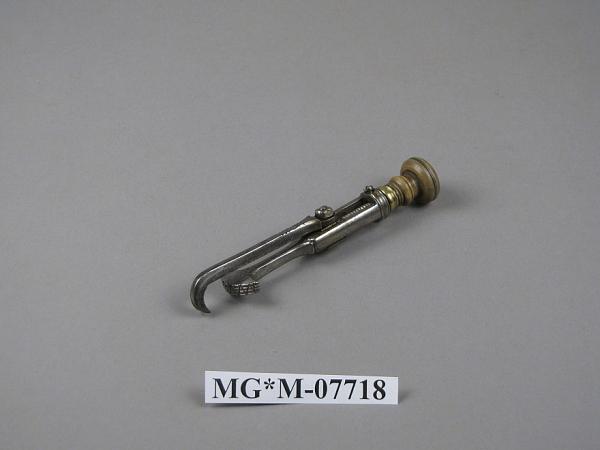 | 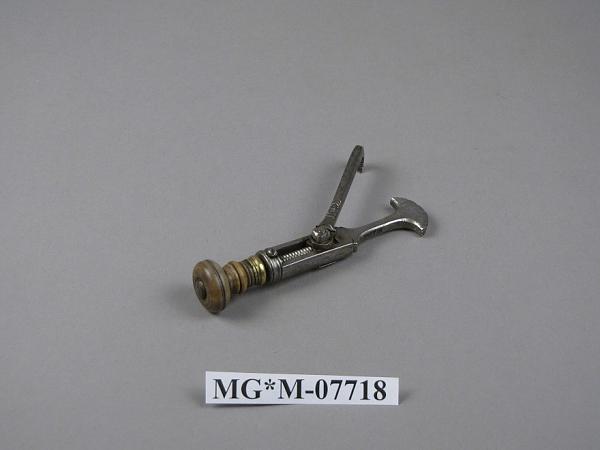 |
Source: Smithsonian
There’s one last tidbit I’d like to get into while discussing this game, and that is the exact exact means of tooth extraction. I did a bit of historical research on tooth removal protocols, and it turns out that a lot of the tools used for this have not changed for centuries– I ultimately settled on using the humble dental pelican, a tool that was ultimately phased out for the older tooth key because, by sheering out the tooth sideways, it was disproportionately likely to cause damage to the surrounding jaw and gums.
But like the torturer in WITH TEETH, I fundamentally wanted this to hurt.
This characterization for the torturer interplays a bit with the piece’s time period ambiguity. If the magic in a tooth can ‘die’ and it must be extracted in whole to be ‘stolen’, then for a dental pelican to be considered best practice the story would have to take place somewhere around the 16th-18th centuries; This is directly at odds with the language used– orthodontics in a recognizably modern form did not exist until the industrial revolution, and the word ‘orthodontics’ itself dates to the early 20th century. We do not know when “our age of magic” really is, just that our torturer’s actions are anachronistic.
At the start of the story, the victim assumes that the torturer is doing this for their own gain (something conveyed succinctly with the uncreative moniker “magic thief”), but as the curtain is pulled back and more about both the world and the characters are revealed, it becomes clear that this is not the case. The game climaxes at the realization that this is purely an act of sadistic hedonism, and closes on the note that the torturer has both done this before and proudly wears the marks of doing this.
Further reading: Dental Imaginaries in 19th Century Literature and Culture, Eleanor Chantelle Faulkner
WHAT HATH GOD WROUGHT
It is probably unsurprising for me to say that WHAT HATH GOD WROUGHT is also a game that started with a core conceit for how the world would work.
In my opinion, “worldbuilding” is a concept with very different connotations to different people. To many, it conjures notions of bullet point lists about topics like holiday traditions and jargon– things that can make for interesting decoration in a narrative, certainly, but are not the conceptual framework needed to deliver the intended themes and plot of a story. Personally, I agree with what Ada Palmer has to say: that the worldbuilder’s craft is the same as the historian’s, an art of drawing throughlines between disparate events in order to make statements about the sociopolitical and economic forces that steer the world.
And many of the throughlines from the world of WHGW to our modern day should be obvious. I am far from the first person to draw parallels between the current state of generative AI and prior tech bubbles6, and I doubt that I will be the last. By writing a game about generative AI that only minimally includes computers (and their output), we are free to focus on the other effects of the technology: decreasing the signal-to-noise ratio of an increasingly corporatized internet, the environmental impact of new datacenters on the surrounding (often lower-income) communities, the erosion of skilled labor and how this causes growing class disparity, the way an outside agent that mirrors one’s beliefs can further entrench them, etc. etc.
That said, there is one component of the setting that I feel is more about stylizing and underscoring the way it feels to live through such a time than is about a historical argument about the impacts of the technology: if we stop feeding our demons data, the world will not end tomorrow. But given how the average person is helpless to do anything about this industry-backed juggernaut that feels as though it is consuming the world around them, we can relate to the people in the world of WHGW have no choice but to watch as the economy warps around this existential threat.
I’ll spare this essay some of the specific decisions that were made when putting together the setting for this game. Just know that both Fisher and Laplace Atelier were involved in the early back-and-forth that pinned a lot of the specifics down, after I provided the initial pitch. This world would be very different without their contributions.
Reject Nostalgia, Turn to the Future
Setting WHGW shortly after the peak of the dot-com bubble in an alt-history where that bubble never popped both worked to cement some of our thematic parallels and gave us a delicious set of aesthetics and cultural influence to draw from.
Y2K throwbacks are in vogue, for everything from fashion to the growing popularity of oldweb-inspired services like Neocities and webrings7. But, even when looking back at these times with fondness, I think it is important to avoid the sweet poison of nostalgia, the fascist impulse to revisit an older time as though it was a physical space.
The experimental digital artist Nathalie Lawhead wrote an optimistic piece about the nostalgia in indie/weird-games for Web 1.0, often found in those who never lived through the time themselves. The crux of her argument is:
If I was to point at any one instance in internet history to say “this is where it all changed for the worst”, I would point to when business started to “take the internet seriously”.
I argue that such a time never existed.
The moment the internet shifted from an internal research project by the department of defense to something available to the public, companies have been trying to extract value from it. The internet is not, in the economic sense of the term, free. It takes human effort to extract copper and rare earth metals from the ground to make wire and other hardware, to bury cables and keep up with maintaining them, to generate the electricity to run servers and replace failing hardware; The people who perform this labor deserve to be fairly compensated. While there are arguments to be made about who should be responsible for footing the bill, under our present economic system one cannot deny that companies providing access to this grand series of tubes have incentive to seek increasing payment for it.
By the time of the examples cited in the article, the movie Hackers (1995) and the essays “A Declaration for the Independence of Cyberspace” and “Cyberselfish” (1996), the hooks had already been set for many of the modern conflicts that we face on the internet today.
Services like Prodigy that simplified the process of getting online had to be supported by advertiser funding in order to stay in the black. By 1991, Prodigy had already pioneered the banner ad and began to censor anyone who spoke ill of advertisers on their forums or messaging services. Companies revoking user content because they are beholden to the advertisers that maintain their bottom line– stop me if this sounds familiar.
1995 saw the birth of advertising behemoth DoubleClick, who would lay the groundwork for advertising agencies providing software-as-a-service as well as leveraging unique user fingerprints and a real-time bidding system in order to optimize the number of ad click-throughs. If this kind of combined rent-seeking-behavior combined with selling users as a product sounds familiar, that’s probably because it’s the same basic revenue model as Google Ad Services, who would eventually acquire the company. There would later be a class-action lawsuit brought against the company for violating user privacy by compiling information on their online habits without their knowledge or consent– stop me if this sounds familiar.
As much as we regard Geocities as a bastion for easily-accessible individual expression during the Web 1.0 era, we shouldn’t forget that in 1997, after the invention of javascript, the service invented what would later become known as the “pop up ad” (and this was before the controversial acquisition by Yodel Yahoo that would drive the platform to become even more profit-oriented). Browser developers would work on tools to stop the obtrusive ads, creating a game of cat-and-mouse between those who profited from user eyeballs and users who wanted a better web-surfing experience– stop me if this sounds familiar.
The power of looking to the past in order to feel hope for the future should not come from nostalgia for an era that never existed, where the original sin that would cast us from the Garden of Eden had not yet been committed; It is that knowing that people in the past had to contend with many of the same issues that we do today, and that they fought back and survived.
The Belief is Out There
One thing I wish we could have done a more concrete job solidifying was the importance of belief and how it interplays with all of the economic and supernatural forces that drive the game. A tech bubble cannot exist without a critical mass of investors to believe in it; Organized religion cannot exist without a critical mass of patrons to believe in it; AI psychosis cannot exist without a critical mass of amplified thoughts repeated back to the person who believes in them.
Belief is the glue that fills in the cracks when other explanations for the way the world works fail. While we kind of touch on this with the timing (and implied cause) of The Great Crash as well as the nature of how demons appear to people, there was a lot that we left on the table.

Rachel’s status as a practicing Roman Catholic scientist was something that I decided on relatively early on, and is a topic somewhat close to my heart– I am a scientist who was raised in the Catholic church, although I stopped genuinely believing in religion in my teens when I parsed that many stories in the bible were meant to be taken as metaphors to guide social behaviors.8
I was also not very old when I learned to code switch when questioned in my beliefs. The answers that I gave at Sunday School were different to the answers that I gave to my mother (a catholic scientist)9 were different to the answers that I riddled out for myself inside my own head. While I don’t think that the scientist’s view of empirically understanding the world through study is something that has to be innately incompatible with belief in a higher power, but as I understand things now, I do think that you have to take a few liberties from the Catholic Church’s teachings in order to reconcile these belief systems.
I really wish that we could have gone into greater depth about how Rachel holds these (superficially conflicting) belief systems in balance, but by the time that I realized we were wholly overlooking this the script was already growing past our ability to easily sustain it in the limited time of the jam. Maybe on the next one.
Further reading: God is a Fiery Accelerant, Erik Davis
Robert Silverberg’s Science Fiction 101
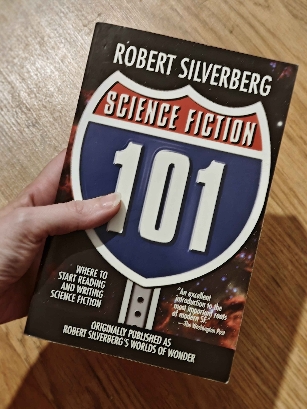
I greatly enjoy the form of the SFF short story, and this book is a delightful collection of them. Aside from being an anthology, there is commentary between each work by the curator of the collection, Robert Silverberg, often going into the cultural context of the work’s original publication and analyzing the work itself, highlighting themes and dissecting effective narrative devices– It’s like having a mini-bookclub baked-in to the book itself. That said, there are definitely points where I disagree with what Silverberg has to say about a story.
The stories in the book run the gamut from the crunchy and detail-oriented to the lyrical and emotional, but the overwhelming feeling across the selected works is a sense of wonder. The last story in the collection, Day Million by Fredrerik Pohl, is a story that paints mundane life in the distant future as something wondrously different to our own, which works well as a capstone to a collection. (It’s a particularly short short story, you could probably go read it now without losing the cadence of this post too much.)
This is the gist of what Silverberg has to say about it:
Long before the term “future shock” became a cliché, Pohl realized that the world is in a state of rapid metamorphosis in which change has been coming at an almost unimaginable rate: and in which that rate will continue to accelerate. Reality makes science fiction look timid; what most writers imagine as the world of 2583 will be old stuff before the year 2050, and if we could see the true world of 2583 it would be virtually unrecognizable to us. […] “Day Million” is framed in the form of a challenge to our complacency.
But… is this unimaginable shift really all that the story is saying? I want to highlight this particular snippet, emphasis added.
About this business of her being a boy. It didn’t matter to her audiences that genetically she was male. It wouldn’t matter to you, if you were among them, because you wouldn’t know it—not unless you took a biopsy cutting of her flesh and put it under an electron-microscope to find the XY chromosome—and it didn’t matter to them because they didn’t care. Through techniques which are not only complex but haven’t yet been discovered, these people were able to determine a great deal about the aptitudes and easements of babies quite a long time before they were born—at about the second horizon of cell-division, to be exact, when the segmenting egg is becoming a free blastocyst—and then they naturally helped those aptitudes along. Wouldn’t we? If we find a child with an aptitude for music we give him a scholarship to Juilliard. If they found a child whose aptitudes were for being a woman, they made him one. As sex had long been dissociated from reproduction this was relatively easy to do and caused no trouble and no, or at least very little, comment.
How much is “very little”? Oh, about as much as would be caused by our own tampering with Divine Will by filling a tooth. Less than would be caused by wearing a hearing aid. Does it still sound awful? Then look closely at the next busty babe you meet and reflect that she may be a Dora, for adults who are genetically male but somatically female are far from unknown even in our own time. […] The difference is that […] the people of Day Million did it often, on purpose, because they wanted to.
Well, that’s enough to tell you about Dora. It would only confuse you to add that she was seven feet tall and smelled of peanut butter. Let us begin our story.
While I would agree that this excerpt is meant as a challenge to the reader’s complacency, it is not spinning a yarn set in a distant future that is wholly detached from the author’s own time10– part of the challenge to the reader’s complacency comes from pointing out that some of elements of this story exist in our current time, and in ways that many people may not notice. I don’t think Robert Silverberg did.
To borrow the (perhaps cliché) words of another SF author,
The future is already here– it’s just not evenly distributed
– William Gibson
And this, to me, gets at the heart of what Science Fiction is about. We tell stories about hypothetical what-ifs and the future in order to talk about today; Abstracted metaphors that highlight the underlying emotional truth of a situation, built with the knowledge that the future is built from historical throughlines that started in our past.
To quote the prescient Ocavia Butler in her short essay, A Few Rules For Predicting The Future, written in 2000,
“SO DO YOU REALLY believe that in the future we’re going to have the kind of trouble you write about in your books?” a student asked me as I was signing books after a talk. The young man was referring to the troubles I’d described in Parable of the Sower and Parable of the Talents, novels that take place in a near future of increasing drug addiction and illiteracy, marked by the popularity of prisons and the unpopularity of public schools, the vast and growing gap between the rich and everyone else, and the whole nasty family of problems brought on by global warming.
“I didn’t make up the problems,” I pointed out. ‘All I did was look around at the problems we’re neglecting now and give them about 30 years to grow into full-fledged disasters.’
If reality makes science fiction look timid, it’s only because it is being taken too literally. Writing science fiction is the art of using what-ifs to deeply explore our present reality.
Further reading: The Importance of Reading (and Teaching) Cyberpunk in the Age of AI, Joanna Nelius-Free
In closing
Woof, this has been my longest blog post to date. When I first set out to write this meandering post I didn’t really think that it was going to be this long, but I suppose that it should not be a surprise to myself that I have a lot of words to say on topics that I feel passionate about. Thanks for sticking through with this ‘till the end.
Site updates
Been a minute since I had one of these headings, eh? I’ve been on a kick of tinkering bits and pieces of this site, partially brought upon by seeing more pages by fellow TYVNJ participants.
- Added toybox
- Added shrine page
- Added improved last.fm now playing widget on landing page
- Minor restyling
- Middle column of layout is now centered when all 3 columns are visible
- Tweaked welcomments section
- External links now have icon to indicate opening in a new tab (you probably noticed this already)
- Implemented littlefoot.js footnotes (another thing obvious in the contents of this page)11
I admit that I kind of want to rip out and replace parts of the backend now that I have a stronger grasp of jekyll, as well as rework large chunks of html/css now that I know about standards that were written after 2006… but we keep moving forwards. 🏃♀️➡️
Footnotes
-
That said, I still tinkered around with some renpy capabilities that I haven’t touched before– in particular I learned about proxy functions when trying to get the text auto-pause function to behave properly. ↩
-
Yeah, yeah, this article’s been passed around a ton since it was first published. I wanna go on a tangent here about one of the things it brings up– when discussing how 80’s musclebound action stars often portrayed their characters in a way that openly acknowledged sexuality, the example given for Arnie is seeing his bare ass in Terminator. To me, the thing that comes to mind is the scene at the start of Total Recall, where Arnie’s character is playing around in bed his girlfriend. This gets taken a step further when we later learn that the ‘girlfriend’ is actually an undercover spy, and we see her analyst allies joking around with her husband (a fellow spy) that he’s getting cucked by Arnold fucking Schwarzenegger. Does anyone else remember this? Just thinking about it makes me feel insane. (…maybe the author didn’t bring up this example because it could have derailed the discussion, much as this footnote has.) ↩
-
A game that I have only experienced through streamers and hold no other fondness for– so don’t expect me to elaborate on any other elements of it. ↩
-
I feel the need to add a disclaimer here around the conversation with disability: I am saying this in the terms that it is viewed by society, not because I agree with it or that I think it’s right. Regardless of one’s own thoughts on toothlessness, being seen as (even less) of a person by greater society is a valid fear. ↩
-
Well, unless it’s off-putting male-on-female violence that doesn’t question the social dynamics behind that. Which is the default in non-queer spaces. So it goes. ↩
-
You better believe in the Web 1.0 Renaissance– you’re lookin at it! ↩
-
Maybe I’ll make a game about this one day, but I feel like We Know The Devil honestly comes pretty close to some of my personal experiences. It was only one weekend, but I remember the sleepaway camp that was a part of my confirmation program vividly: God Given by NIN coming up on shuffle on my iPod as mom’s car rolled up to the school basketball court; waiting too long for the buses to arrive as I read a free epub about Ōmukade and other Japanese myths on my eReader; passively befriending the other queer neurodivergent weirdos as we failed to connect with the larger group; being asked out by another girl for the first time; watching in silent horror as she didn’t know to lie about her beliefs on abortion during instructor-led discussion, and the way her speech broke down and tics grew in intensity as she wanted more than anything else to be somewhere else; re-reading Neuromancer in my bunk in lieu of trying to talk with anyone… It was a lot, and managed to exemplify exactly how I did not mesh with the church.
I would be confirmed two months later. ↩ -
Truthfully, a lot of my social trauma can be summarized as “second generation woman in STEM”, but that would take a lot more than this blog post (much less this footnote) to unpack. ↩
-
1970, for the record. ↩
-
I may have gotten a bit heavy-handed with the footnotes, knowing that they would be easy to read without losing your place. Unless you printed this page out or have scripts disabled, for whatever reason. ↩
Status for 2026-08-27
Finally getting this blogpost out as I procrastinate on packing for a weekend-long trip
- Now chipping away at: Another blog post about TYVNJ2 games that I enjoyed (it is currently 43 games long)
- Now considering: throwing more money at people to draw my little guys
- Now ready to: lock back in on writing BDSiM
Status feed
Related Posts
previous post 20260715_
Comments
 | "If they think you're crude, go technical; if they think you're technical, go crude." Site contents and theme by Hamaonoverdrive. |
| | "If they think you're crude, go technical; if they think you're technical, go crude." Site contents and theme by Hamaonoverdrive. |
4 comments
rue
gnat
Kili
lemon